The main job of the kidneys is to remove waste products from the blood and return the clean blood back to the body. In short, a healthy kidney provides the following functions:
If one kidney is damaged, the other kidney can enlarge and do the work of two. However, if both kidneys fail, then wastes and fluids would accumulate in the body necessitating dialysis treatment (the cleaning of blood either by a machine or in the abdomen) or a kidney transplant.
Giving the gift of improved health to another person can be a very positive experience. Living donor kidney transplants now exceed the number of transplants performed from deceased donors. As a result, there are more organs available for transplantation. In 2009 alone, there were 231 living donor kidney transplants performed in Ontario. However, the availability of organs does not meet the crucial need of the many individuals on the transplant waiting list.
Although transplantation - from either a living or a deceased donor - is not a cure for kidney disease, it may prolong and enhance one's quality of life.
Click here for more information on living kidney donation.
For more information on kidney disease please go to www.kidney.ca.
Living kidney donors must be older than 18 and generally less than 70 years of age, in good general health without any evidence of significant high blood pressure, diabetes, cancer, kidney disease and heart disease or hepatitis. Gender and race are not factors in determining who can donate.
There are currently four types of living kidney donation in Canada:
Related
Living donors are brothers and sisters, parents, children 18 years of age and older as well as other blood relatives, including aunts, uncles, cousins, half-siblings, nieces and nephews.
Non-related
Living donors are spouses, partners, in-law relatives, close friends, and co-workers.
Paired Exchange
Paired exchange is when two separate but willing donors are each unable to donate to their intended recipients due to blood group (ABO) incompatibility or more rarely because of incompatibility of cross matching. In this program, the willing donors are matched with the other's respective recipient so that each recipient can receive a kidney with a compatible blood type. The paired exchange program is currently being piloted at St. Michael's Hospital and University Health Network's Toronto General Hospital in Toronto.
Anonymous Donation
An anonymous donor is a person who does not know the intended recipient, but donates to a person in need at the top of the transplant waiting list. Anonymous donation has taken place in jurisdictions such as the United States and British Columbia and may be considered in Ontario in the future. For more information on the status of anonymous donation in Ontario, please contact Trillium Gift of Life Network's living donation coordinator at: 416-363-4001 or 1-800-263-2833.
Ultimately, the decision about whether or not to donate remains with you - and only you. Working through the process of making the decision may require some informed - and objective assistance. Speak to the social worker or counselor affiliated with the transplant team or a living donation coordinator. Through discussions you will have a better sense of just how prepared you are to donate.
In addition, think about speaking to family members, close friends, a religious or spiritual leader or someone who has donated already to get more information and support. Research shows that when a potential donor has access to another living donor and others such as living donor support groups, they are better prepared to make a decision.
It is natural to have some concerns about whether or not you're the right person to become a donor and there are some very valid reasons not to donate (although again, only you can decide what these reasons might be). However, experience with living donation indicates the following reasons that donation may not be for you:
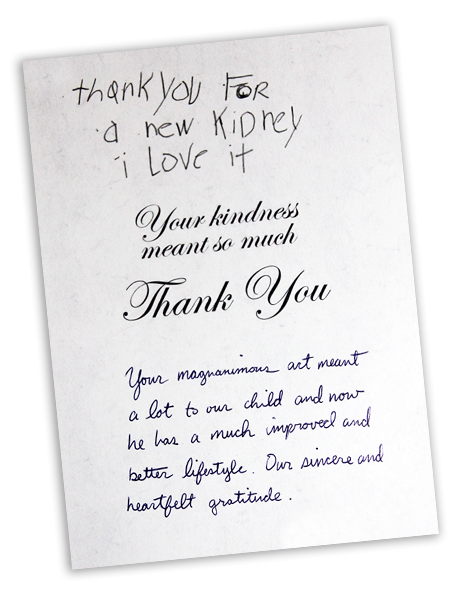
Overall, living donors say they feel honoured to be asked. In one study, the overwhelming majority (96%) says they wouldn't hesitate to donate again if they were given the opportunity. Donors also reported a higher quality of life, which may be related to a greater sense of self-worth following donation.
In the 50 years since living kidney donation began, studies indicate that the health consequences of living with one kidney are minimal. Your transplant surgeon will discuss these risks with you during your consultation.
While the consequences of donating a kidney are minimal and few, there are some precautions that should be taken. For instance, rough contact sports such as football and hockey that could damage the remaining kidney are not advised. Any kidney donor who becomes pregnant after donating should let her physician know so that as a precaution, kidney function can be monitored.
While some studies indicate that kidney donors may have a slightly higher incidence of high blood pressure or proteinuria (spilling protein in their urine), the significance of this post donation is unknown. These risks can be effectively managed with appropriate follow-up care, including regular physical exams and blood and urine tests.